
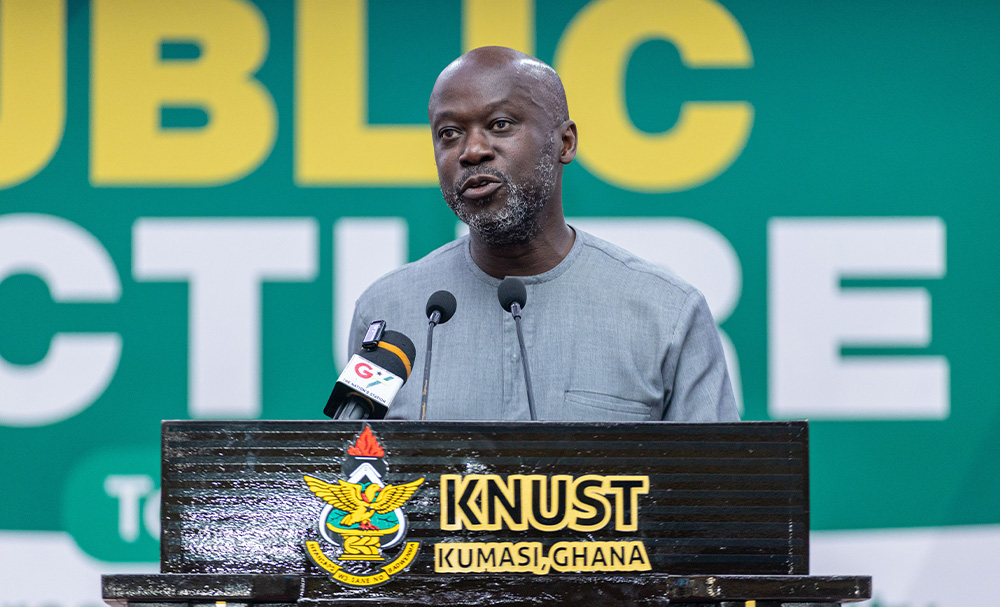
Award-winning Ghanaian-British architect Sir David Adjaye has called on African architects and creatives to embrace material scarcity and local limitations as opportunities for innovation rather than barriers to development.
Delivering a public lecture titled “African Futures: Architecture, Identity and the Power of Cultural Narratives” at the Great Hall of the Kwame Nkrumah University of Science and Technology (KNUST), Sir David Adjaye said Africa’s constraints could become the foundation for globally significant architectural solutions.
The lecture, organised by the College of Art and Built Environment (CABE), brought together students, faculty members and professionals from the built environment sector.
Speaking during the lecture, Sir David Adjaye challenged the perception that poverty and scarcity hinder creativity and progress.
“The poverty that we have is not a hindrance. It’s an opportunity to think differently. The material scarcity is an opportunity to think laterally differently,” he said.
According to him, limitations often create the conditions for radical innovation and originality.
“We cannot say that scarcity is a problem. It’s not an argument. In fact, it’s laughable. In fact, scarcity is an opportunity,” he stated.
“In a world where you can do anything you want, actually to have limits because of whatever you want to say, GDP or import problems, to be able to have limits can be an extraordinary accelerator.”
The globally acclaimed architect noted that creatives have historically used limitations to produce groundbreaking ideas and solutions.
“We are always told limits are a problem but actually, creatives know that limits can create extraordinary expansion and that can create radicality,” he added.
Sir David Adjaye urged African architects to stop waiting for validation through comparisons with Western systems and instead focus on developing architecture rooted in local realities and experiences.
“We can’t be architects saying we’re waiting for some moment when we are like everybody else. We have to create an architecture out of what we have,” he said.
“And that’s what the world is looking at. The world must look at us and say, what can they do with that? And we get acknowledgement when we go beyond their expectations.”
During the lecture, Sir David Adjaye projected and discussed several of his rammed-earth architectural projects, using them to demonstrate how traditional building methods and indigenous knowledge systems can inform contemporary architecture. He argued that African societies possess deep-rooted design intelligence embedded in cultural artefacts, traditional crafts and community knowledge systems.
“Africans are exceptional at reduction, abstraction, tessellation and multiplication. We are the originators of this thing,” he noted.
According to him, generations before colonial disruption embedded complex systems of knowledge in everyday objects and cultural practices.
“They put it into combs, into dresses, into stools, into shrines. It was everywhere,” he said.
He described this continuity of indigenous knowledge as evidence of African resilience and ingenuity.
“There is an incredible intelligence in the absolute knowledge that comes from the people who lived in this place for many generations,” he stated.
“And there is an intelligence in understanding how, if that has worked for those generations, we can marshal that information to create an extraordinary future.”
Sir David Adjaye also stressed the need for African societies to reclaim and apply their own knowledge systems in shaping future development.
“We need to become the masters of our knowledge and then to use it with the technologies that exist in the world right now to imagine our futures,” he stated.
“It’s the time for local knowledge. It’s the time for knowledge systems that have been overlooked to rise.”
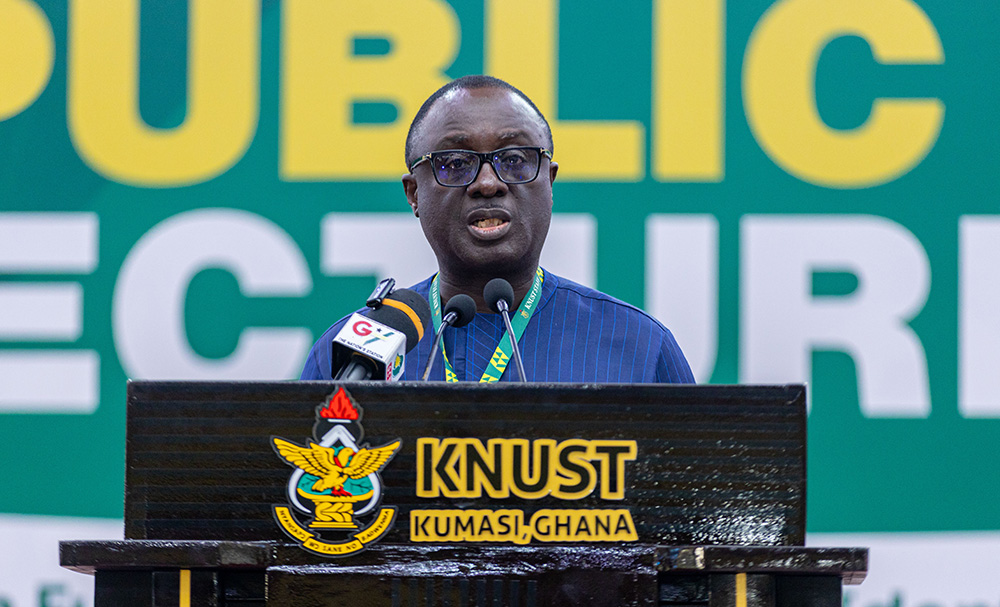
Speaking on behalf of the Vice-Chancellor, the Pro Vice-Chancellor, Professor David Asamoah, described the lecture as an important platform for critical reflection and transformative discourse.
“Ladies and gentlemen, universities are at their best when they create spaces for difficult conversations, bold ideas and transformative thinking. Today’s public lecture embodies exactly that spirit,” he said.
He added that Sir David Adjaye’s global accomplishments demonstrated that international excellence can be achieved without losing cultural identity and authenticity.
“This occasion should serve as a reminder that global excellence is attainable without abandoning one’s cultural roots or intellectual authenticity,” Professor Asamoah stated.
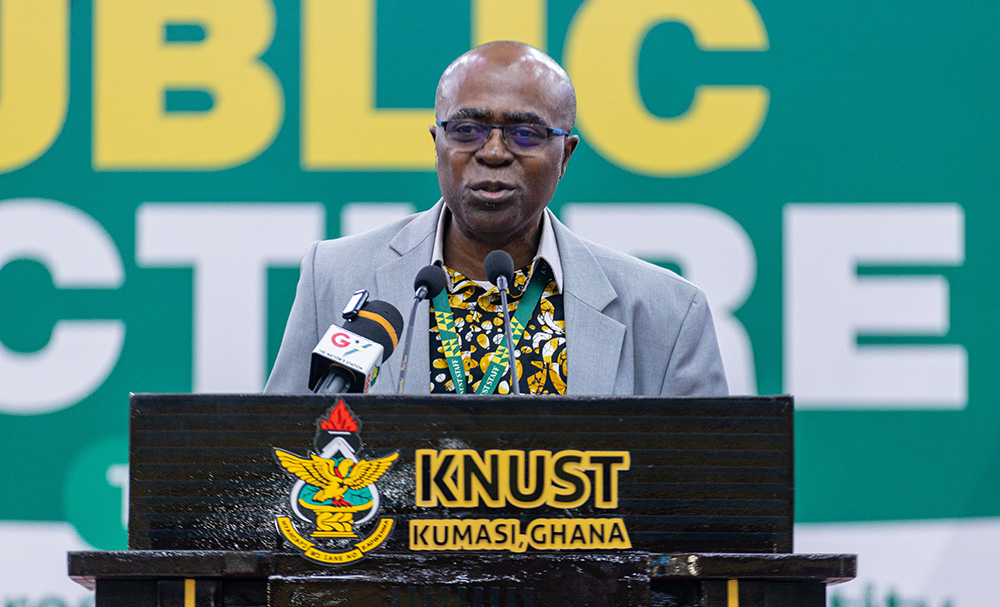
The Provost of the College of Art and Built Environment, Professor Christian Koranteng, described Sir David Adjaye as a globally influential architectural voice whose work demonstrates the cultural and historical power of architecture.
“We are especially privileged to host one of the world’s most influential architects and intellectual voices, Sir Adjaye,” he noted.
“His work reminds us that architecture is not only about materials and form; it is about memory, identity and story. He shows how buildings can hold history, carry aspirations and speak across cultures.”
Professor Koranteng also called for stronger collaboration between academia and industry to drive innovation in Ghana’s built environment sector.
“We are ready to partner with industry to close the gap between theory and practice, to pilot indigenous materials, to test research curricula and to co-create fields that will place problem-solving at the centre of architectural solutions,” he said.


